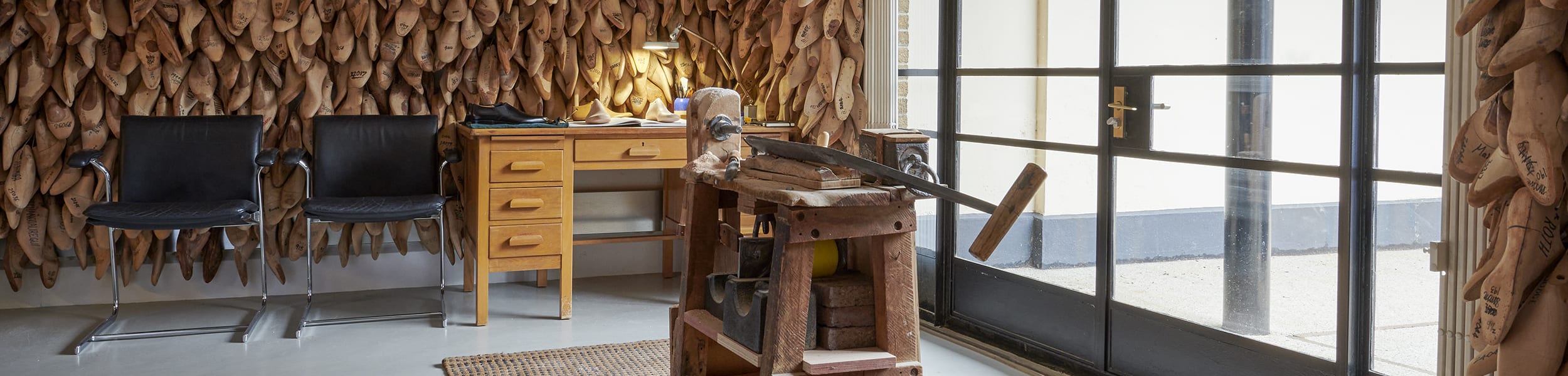
HOW WE MAKE OUR BESPOKE SHOES
An introduction to the specialist skills and methods behind our handmade, hand-welted bespoke shoes.
Whenever a new bespoke last is made at Canons, the shoes are effectively made twice. A separate pair of trial fitting shoes is produced in the chosen leathers and tried on. Following the fitting, the lasts and patterns are adjusted as necessary, the trial shoes are discarded, and the final pair is cut and made afresh.
We follow the methods of traditional English hand-welted shoemaking, with our own techniques in last-making and asymmetrical pattern cutting. Each commission brings together specialist skills, from the initial measurements to the final finishing of the completed shoes.
We follow the methods of traditional English hand-welted shoemaking, with our own techniques in last-making and asymmetrical pattern cutting. Each commission brings together specialist skills, from the initial measurements to the final finishing of the completed shoes.

01 — Measuring and Consultation
Every commission begins with a consultation with our Last-maker, either at our London workshop or during one of our regular international trunk shows.
The appointment typically lasts around one hour. Approximately thirty minutes are spent examining both feet, taking detailed measurements, preparing outlines and recording observations about their characteristics and fitting requirements.
The remaining time is spent discussing the client’s preferred styles, selecting leathers and considering the details of the proposed shoes.
These measurements and observations provide the starting point for making the bespoke lasts.
02 — Last-Making
The last is the wooden form around which the shoe is constructed. It determines much of the fit, shape and proportions of the finished pair.
Using our own last-making techniques, we carve a beechwood last for each foot by hand. A bespoke last is not simply a wooden reproduction of the foot. It must accommodate the foot’s characteristics while achieving the intended fit and shape of the shoe.
We develop separate lasts for different styles of footwear, including Oxfords, Derbies, loafers and boots. This allows each style to be fitted according to its requirements, rather than relying upon a single last for every design.
Additional lasts may also be made to accommodate different sock thicknesses or footwear intended for a specific use.

03 — Pattern Cutting
Pattern cutting is central to our approach to bespoke shoemaking.
Using our own asymmetrical pattern-cutting technique, we translate the three-dimensional contours of each last into two-dimensional patterns with particular accuracy.
The resulting upper is itself asymmetrical, corresponding more closely to the form of the last upon which it will be made.
This reduces the distortion and adjustment required when the Shoemaker draws the leather over the last, helping to preserve the intended fit, shape and proportions of the design.
Each pattern is developed specifically for the client’s lasts and the chosen style of shoe.
04 — The Trial Fitting
Whenever new lasts are made, whether for a client’s first commission, a different style or a change in fit, a new pair of trial fitting shoes is produced using the same leather, linings and principal components intended for the finished pair.
These are clicked, closed and lasted in preparation for the fitting, allowing our Last-maker to assess the shoes on the client’s feet before the final pair is made.
During the fitting, attention is given to the heel, instep, forepart and overall balance and proportions of the shoes. Any adjustments required to improve the fit or appearance are recorded.
The lasts and patterns are then adjusted as necessary. Once these corrections have been completed, the trial shoes are discarded and the leather components for the final pair are cut afresh.
Further trial fittings may be arranged where required.

05 — Clicking
Clicking is the specialist process of selecting and cutting the leather components from which the shoe uppers are assembled.
The Clicker examines each skin, considering its grain, natural markings, direction of stretch and the suitability of different areas for the intended components.
Using the prepared patterns, each piece is cut by hand, with attention to the selection of the leather and the matching of its appearance and characteristics across both shoes.
06 — Closing
Once the leather components have been cut, they pass to the Closer, who prepares and assembles the uppers.
The leather is skived where necessary, reducing its thickness at seams and edges before the components are joined and stitched. Linings, reinforcements and other details are incorporated according to the chosen design.
The completed uppers follow the form of their respective lasts, allowing the Shoemaker to maintain the intended shape and proportions during lasting.
The accuracy of the closing contributes to the shape, fit and appearance of the finished shoes.
07 — Shoemaking
The Shoemaker constructs the shoes around the client’s lasts, beginning with the preparation of the leather insoles.
The completed uppers are shaped and secured over the lasts in a process known as lasting. A leather welt is then stitched by hand to the upper and insole using waxed flax thread, forming the foundation for the attachment of the outer sole.
The outer soles are attached and the heels built and shaped by hand, with attention to the proportions and intended character of the design.
Traditional hand-welted construction provides a durable and repairable method of shoemaking, allowing the shoes to be maintained and rebuilt throughout their working life.

08 — Tree Making
Each bespoke pair is accompanied by wooden shoe trees, individually carved by hand from beechwood by a Master Tree Maker.
Made as exact copies of the corresponding lasts, the trees support the original shape of the shoes, help the leather recover after wear and minimise distortion and creasing.
We consider properly fitted wooden shoe trees the single most important element in the ongoing care of bespoke footwear.
Made as exact copies of the corresponding lasts, the trees support the original shape of the shoes, help the leather recover after wear and minimise distortion and creasing.
We consider properly fitted wooden shoe trees the single most important element in the ongoing care of bespoke footwear.
09 — Finishing
Finishing is carried out entirely by hand at our London workshop, using our own leather-colouring technique to achieve a much broader spectrum of colours and tones than those supplied by the tanneries.
Every pair undergoes this process, which can take many hours as the colour is developed by hand to achieve the desired result.
The leather is then polished using a traditional finger-polishing technique, applying wax and water to fill the grain and build up the final finish.
Every pair undergoes this process, which can take many hours as the colour is developed by hand to achieve the desired result.
The leather is then polished using a traditional finger-polishing technique, applying wax and water to fill the grain and build up the final finish.

Future Commissions
Your bespoke lasts and patterns are retained at our London workshop and provide the foundation for future orders.
Subsequent pairs made using established lasts and patterns generally have a shorter production time, as the initial development and trial fitting stages have already been completed.
A new style or change in fitting requirements involves making new lasts and patterns, followed by a further trial fitting.
Commissions requiring new lasts and patterns typically take approximately nine months, depending on the complexity of the work and our workshop schedule. We can confirm current production times when an order is placed.

Repairs and Aftercare
Hand-welted bespoke shoes are designed to be maintained and repaired throughout their working life.
When a pair requires resoling, the shoes must be returned to our London workshop, where they are placed back onto their original bespoke lasts.
The soles and heels are replaced using traditional hand-welted methods, with attention to preserving the shape, fit and construction of the original shoes.
Returning the shoes to their original lasts during this process is essential to maintaining their individual shape and fit.
Commissioning Bespoke Shoes
We welcome clients by appointment at our London workshop and during our regular international trunk shows.
For further information or to arrange a consultation, please contact us. A member of our workshop team will be happy to assist you.
For further information or to arrange a consultation, please contact us. A member of our workshop team will be happy to assist you.